There are books you can remember, and then there are books that only exist while you are reading them. The Master and Margarita belongs to the second category. Not because you are distracted, but because this book refuses to be possessed afterward.
It exists only while you are moving through it, and disappears the moment you try to hold it still.
Someone might say that if you cannot remember it clearly, then you did not really understand it.. Boring! I believe the opposite. I believe you understood it precisely because you cannot fix it in place. Those who claim to “remember it perfectly” are just reducing it.
BEING COMFORTABLE IN CHAOS
I didn’t find this book in a stable moment of my life. And I do not think that was accidental.
At the time, I lived inside an environment that looked free.. but was actually just loud. I felt too fine, which is always a bad sign. Around me there were nights, people, substances.. all of it passed off as intensity. In truth, it was suspension. Confusion was not an accident; it was a strategy. An elegant excuse for not deciding anything real.
What unsettled me was not the chaos itself, but the imbalance. Some of the people around me were just as lost as I was, yet they had language. Angela, for instance. She studied, then showed up to the same parties, the same mess. She fell apart like everyone else, but she knew things. I didn’t. That gap felt brutal. Watching knowledge survive inside excess felt almost unbearable.
The book came into my life right there. I asked a simple question: what’s your favourite book? This one. I bought it. And I was pulled into their world. A world where people could be lost and still know things. I realised I needed to understand more.
A BOOK OF MADMEN
At the beginning, the book offers no handhold. It does not explain itself. It simply appears as a book of madmen.
A BOOK OF MADMEN!
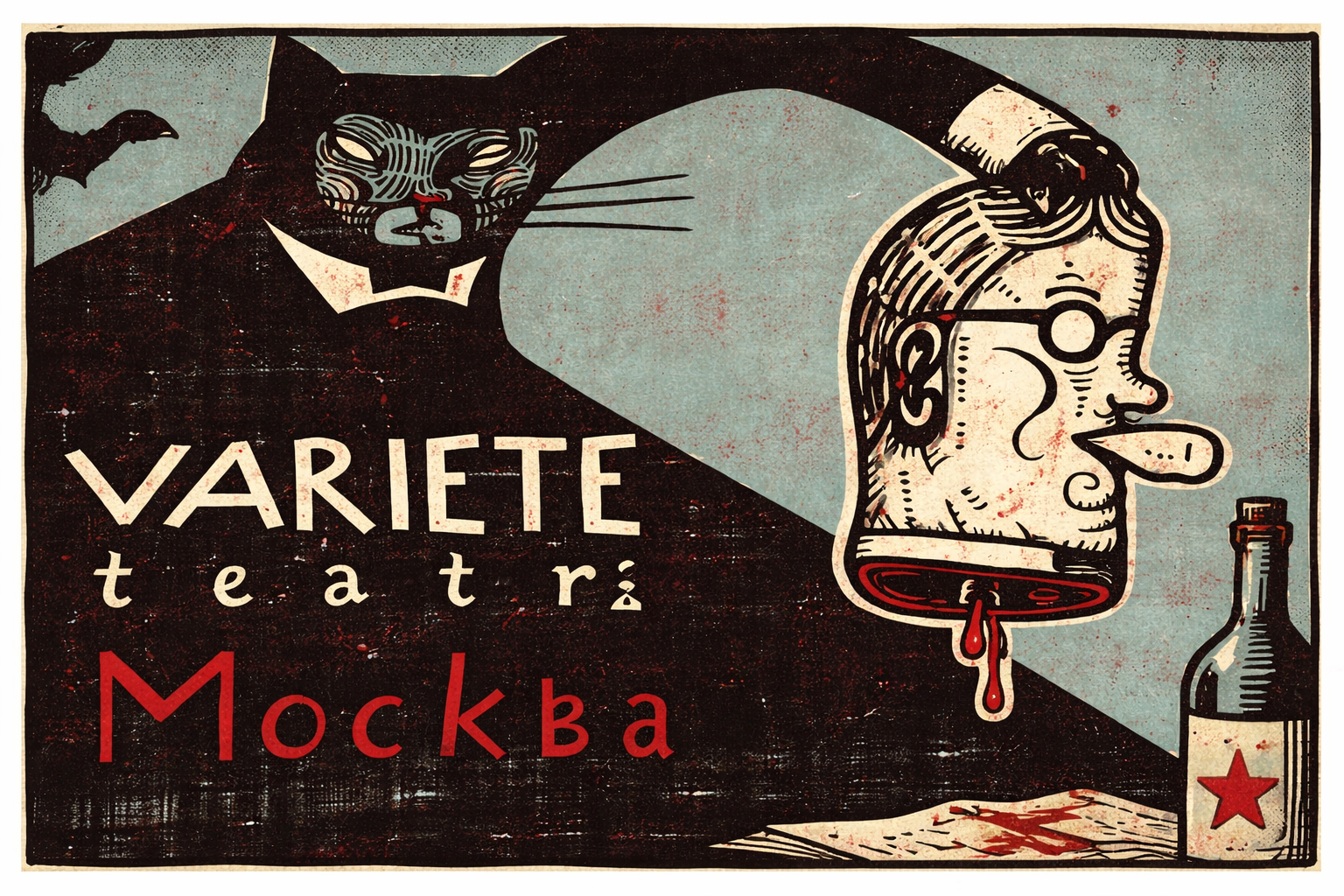
It opens with a stranger calmly telling a man that he will die by decapitation. It is not metaphor. It is not prophecy dressed as dream. Shortly after, by a tram, his head is actually cut off. Just like that. No warning. No moral. No protection.
Chaos. Magic. Madness.
The world derails without asking permission, and instead of recoiling, you feel relief. Because nothing is in its place and, yes, neither are you. You laugh. Then you stop laughing. You start to feel watched.
That is when you understand that the chaos is not random. The book is not improvising.
MANUSCRIPTS DON’T BURN
The devil arrives in Moscow and his name is Woland. Woland is Stalin. Not metaphorically, not partially: he is Stalin. Absolute power on that period that observes everyone and is never observed in return. Arbitrary authority that decides who disappears, who is humiliated, who is spared, often for sport.
Bulgakov never states this openly. He does not need to. Woland has no horns, no sulfur, no theatrics. He has precision. He has administrative cruelty. He arrives, evaluates, rewards and punishes with the same indifference. Everyone fears him. No one names him. Moscow already belongs to him.
This is the moment when the novel stops being merely surreal or grotesque. Beneath the magic, beneath the severed heads and theatrical madness, there is a chillingly lucid portrait of total power.
Bulgakov never speaks of the Church. He never preaches. He never names politics directly in this book. And yet religion is everywhere: not as faith, but as weight. Perhaps that is why, despite being an atheist, this remains one of the most important novels of my life.
The Master (which is Michael Bulgakov!!) writes a novel within the novel, about Pontius Pilate. He loses it. He burns it. He destroys it. At some point, how no longer matters. Because the sentence arrives anyway.
MANUSCRIPTS DON’T BURN
It is not just a literary line. It is a challenge. A declaration of resistance. A refusal of erasure. The promise that what is written against power will return, even when it has been censored, buried, or silenced.
Then there is Margarita. Not a symbol, not an idea. She was Bulgakov’s third wife. And that changes everything. And then there is the ball: excessive, grotesque, full of bodies, noise, the damned of the world. A reversed mass staged in the heart of Moscow, inside a state that declared itself atheist.
That is where you stop reading it as a novel. Plot becomes secondary. What remains is force. A book that does not ask you to understand, only to stay. And when you later try to remember it, it slips away.
Like all real things do.
Leave a Reply